
Carport · CA
Metal Carports in California
A carport is mostly open air, which is exactly why California's regional climate split matters so much for one. The State Climatologist describes California's climate as Mediterranean overall, but that single label hides an enormous range: north coast areas can average over 100 inches of annual precipitation while southeastern deserts see under 5 inches. A carport sited to shed heavy coastal rain and one sited purely for sun protection in a desert are answering different problems even though both are the same building type. On code, California runs a single statewide framework — Title 24, administered by the California Building Standards Commission — which is a more consistent starting point than a purely local-adoption state. But CAL FIRE separately classifies land into Fire Hazard Severity Zones by statute, based on fuel, slope, fire weather and wind, and that classification is parcel-specific; an open carport sited near vegetation in a mapped zone is worth checking against that lookup before placement is finalized.
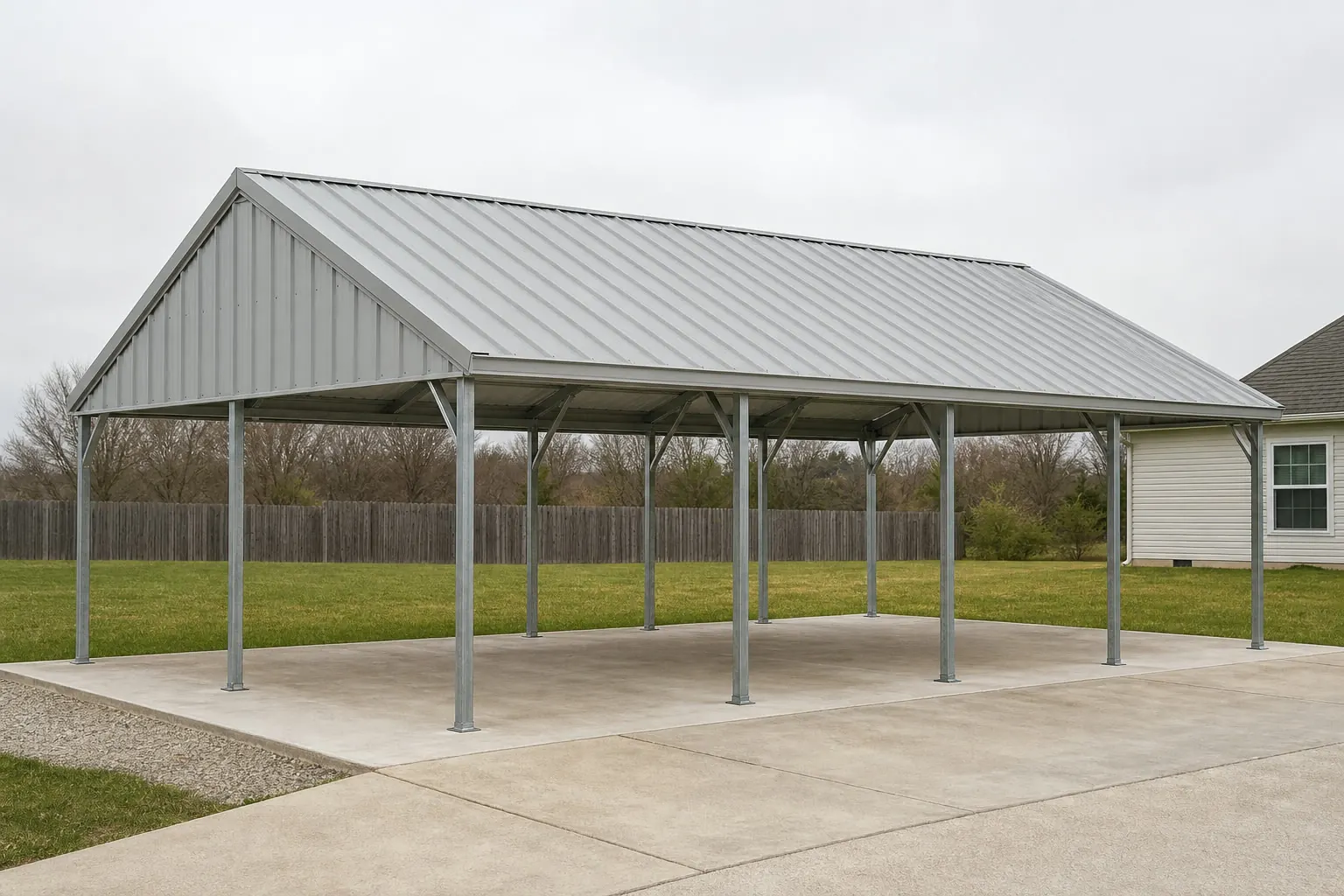
The intersection
California's coast-to-desert range decides what a carport is protecting against
A carport is open by design, so the state's regional climate split matters more for it than for an enclosed building.
The California State Climatologist describes the state's overall pattern as Mediterranean, with precipitation concentrated October through April and dry conditions the rest of the year. That single description, though, spans a huge range: north coast areas can average over 100 inches of annual precipitation, while southeastern desert areas see under 5 inches. A carport near the north coast is primarily managing heavy seasonal rain runoff and roof drainage; a carport in a southeastern desert location is primarily managing sun exposure and heat, with rain a minor factor. Both are entirely normal California sites, but the design conversation each supports is different.
None of this is stated here as a design value — a specific rainfall total or wind figure belongs with your local building department or a licensed engineer, not a state-level guide. What is worth carrying into a quote conversation is a plain description of the actual site: which part of the state it is in, how exposed it is, and what the ground and drainage pattern look like.
Process
One statewide code, one parcel-specific fire lookup
California runs a single Title 24 framework, but CAL FIRE's Fire Hazard Severity Zone program is mapped parcel by parcel, and both matter for where and how a carport goes in.
The California Building Standards Commission administers Title 24 of the California Code of Regulations as one statewide building-standards framework, which is a more consistent baseline than a state where every city or county adopts on its own schedule. Your local building department still applies that framework to the specific parcel and structure, so confirming requirements with them remains the necessary first step.
Separately, CAL FIRE is required by Public Resources Code 4202 and Government Code 51178 to classify land into Fire Hazard Severity Zones based on fuel loading, slope, fire weather and wind. This is a statutory mapping program, not a single statewide rating — the zone that applies depends on the specific parcel. An open carport sited near vegetation, wood fencing or an attached structure in a mapped zone is a reasonable thing to check against that classification before finalizing placement, even though a carport itself is not a residence.
Neither system is described here with a specific code edition, permit threshold or zone designation, because none of those generalize safely to a state-level page. Both are the reason to start the local building department and CAL FIRE conversations early rather than after a carport is ordered.
- Confirm your Title 24 permit path locally
- Your building department applies the statewide framework to your specific structure and parcel.
- Check your parcel's fire hazard zone
- CAL FIRE's mapping tools or your local fire authority can confirm the classification for your address.
- Describe placement relative to vegetation and structures
- This matters more for an open carport in a mapped fire zone than for a fully enclosed building.
Site context
How California's geomorphic provinces change carport siting
The California Geological Survey's 11 geomorphic provinces are a practical lens for anticipating site work under an open structure.
Coast Ranges
Higher precipitation and sloped terrain in parts of this province make roof drainage and grading around an open carport worth planning for up front.
Central Valley
Generally flat terrain simplifies grading, but summer heat and sun exposure tend to drive the design conversation more than drainage does.
Mojave and Colorado Desert provinces
Under 5 inches of average annual precipitation per the State Climatologist means sun protection, not rain shedding, is the primary job of a carport here.
Sierra Nevada and mountain provinces
Elevation and slope change access and grading; a local site visit is the only reliable way to plan a specific mountain-adjacent carport.
Get California carport quotes
Tell us your region, fire hazard zone status and rough footprint. We route it with the California and carport context already attached.
Configuration
What California carports are usually asked to do
The region a site sits in tends to decide which configuration makes sense more than the vehicle count alone.
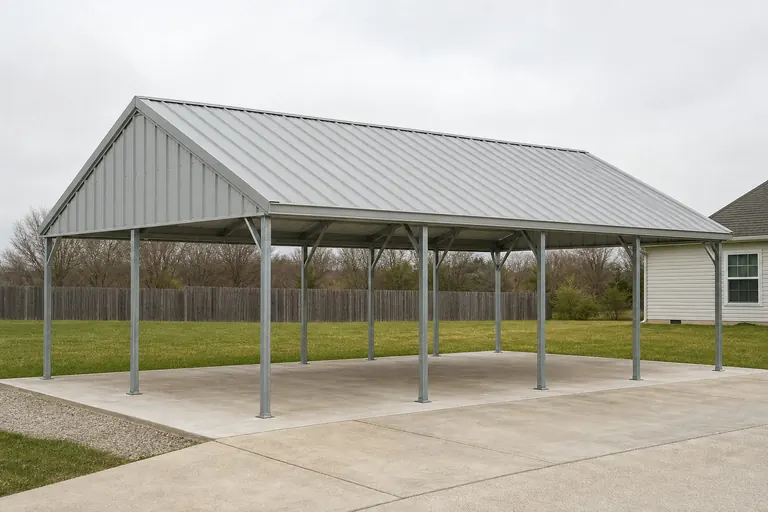 Daily vehicle coverA straightforward open bay sized for one or two vehicles, common on urban and suburban California lots.
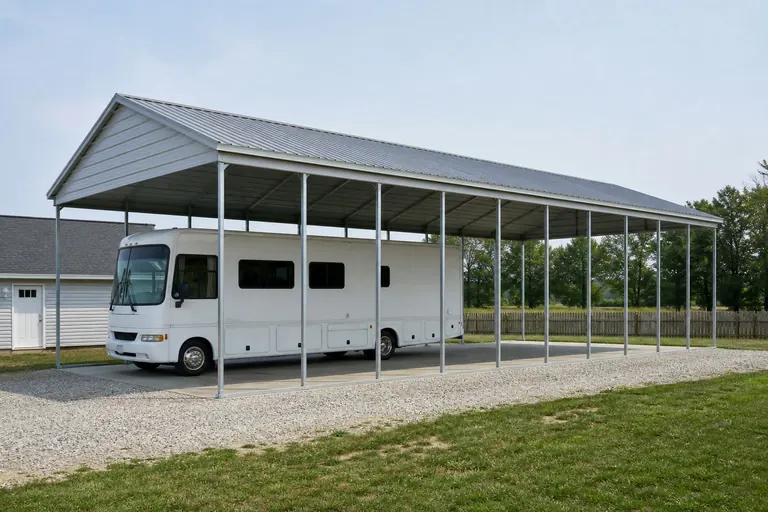 RV and trailer coverTaller, wider spans for recreational or agricultural equipment, common on larger rural California parcels.
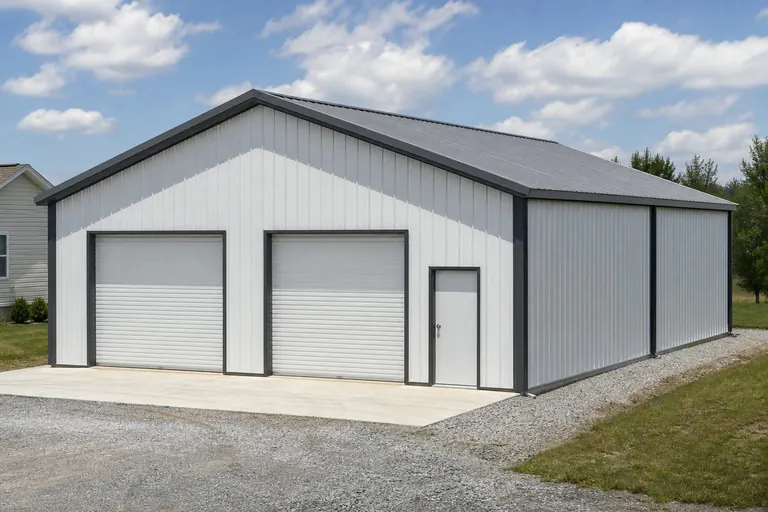 Enclosed alternativeBuyers in mapped fire hazard zones or more exposed coastal sites sometimes reconsider an open carport in favor of an enclosed metal garage; that comparison is worth making before ordering.
Example Configuration — for planning purposes only.
Footprint
Sizes that fit a California carport brief
California enquiries span a wide range, reflecting both compact urban lots and larger rural parcels within the state.
20′ × 20′
400 sq ft
A standard two-vehicle starting point on a typical residential lot.
10′ × 20′
200 sq ft
A minimal single-vehicle footprint where lot width is the constraint.
20′ × 30′
600 sq ft
Extra length for a vehicle plus general storage.
30′ × 40′
1,200 sq ft
Common where RV or trailer cover is added alongside daily vehicle parking on a larger parcel.
Example Configuration — for planning purposes only.
Footprint pages carry layout and clearance detail for each of these; this page only explains why California briefs land in this range.
Preparation
Before you request a California carport quote
A few things settled in advance make a California carport quote comparable rather than a guess.
Step 1
Check your parcel's fire hazard zone
Ask CAL FIRE or your local fire authority whether your address falls in a mapped Fire Hazard Severity Zone before finalizing placement.
Step 2
Confirm your local Title 24 permit requirements
Your building department applies the statewide framework to your specific structure.
Step 3
Describe your region, not just your city
Coastal, valley, desert or mountain siting changes the exposure conversation even within the same county.
Step 4
Decide open versus enclosed
On more exposed or fire-zone-adjacent sites, compare a carport against an enclosed metal garage before committing to either.
Questions
California carport questions
Questions we can answer honestly at state level, with the ones we cannot routed to whoever actually owns them.
Yes, the California Building Standards Commission administers Title 24 of the California Code of Regulations statewide, but your local building department still applies it to your specific parcel and structure.
It can, since CAL FIRE's Fire Hazard Severity Zone program classifies land by fuel, slope, fire weather and wind at the parcel level. An open structure placed near vegetation in a mapped zone is worth checking against that classification with your local fire authority before siting.
Yes, in a general planning sense. North coast areas can average over 100 inches of annual precipitation while southeastern deserts see under 5 inches, per the State Climatologist. Describe your actual region and exposure to whoever quotes the carport rather than assuming a single statewide answer.
There is no official typical size. California enquiries commonly run from a 20x20 two-vehicle footprint up to 30x40 where RV or trailer cover is added on larger parcels.
We do not publish state-level prices, because a credible number depends on your specification, site work and current material pricing. Our cost pages cover what drives the number; a quote covers your building.
Sources for the California facts on this page
This page states no code requirement, wind speed, snow load, permit rule, price or supplier claim. The state-specific facts it does use are listed with their publisher below.
The California State Climatologist describes California as having a Mediterranean climate overall, with precipitation concentrated October through April and dry conditions May through September, strongly modulated by mountains and the Pacific Ocean, with north coast areas averaging over 100 inches of annual precipitation and southeastern deserts under 5 inches.
California Department of Water Resources / Office of the State Climatologist (republished via CoCoRaHS) · n/a (narrative climatology) · Tier 2
https://media.cocorahs.org/docs/ClimateSum_CA.pdfThe California Building Standards Commission (CBSC) administers the California Building Standards Code, Title 24 of the California Code of Regulations, as the state's building standards framework.
California Department of General Services, Building Standards Commission (CBSC) · 2025 Triennial Edition, effective Jan 1, 2026 · Tier 2
https://www.dgs.ca.gov/bsc/CAL FIRE, under the state Office of the State Fire Marshal, is required by law (Public Resources Code 4202 / Government Code 51178) to classify lands into Fire Hazard Severity Zones based on fuel loading, slope, fire weather, and wind, without this evidence assigning any specific zone.
California Department of Forestry and Fire Protection (CAL FIRE) / Office of the State Fire Marshal · current program; 2024 FHSZ maps referenced · Tier 2
https://osfm.fire.ca.gov/what-we-do/community-wildfire-preparedness-and-mitigation/fire-hazard-severity-zonesThe California Geological Survey (state geological survey) divides the state into 11 recognized geomorphic provinces, including the Coast Ranges, Central Valley, Sierra Nevada, Basin and Range, Mojave Desert, Colorado Desert, Transverse Ranges, Peninsular Ranges, Klamath Mountains, Cascade Range, and Modoc Plateau.
California Department of Conservation, California Geological Survey · 2002 (revised) · Tier 2
https://www.conservation.ca.gov/cgs/documents/publications/cgs-notes/CGS-Note-36.pdfFEMA's National Risk Index scores U.S. communities, including California counties, across 18 defined natural hazard types.
FEMA · current dataset · Tier 1
https://www.fema.gov/about/openfema/data-sets/national-risk-index-dataNOAA's NCEI State Climate Summary reports temperatures in California have risen almost 3°F since the beginning of the 20th century, with the six warmest years on record occurring since 2014.
NOAA National Centers for Environmental Information · 2022 report · Tier 1
https://statesummaries.ncics.org/downloads/California-StateClimateSummary2022.pdf