
Steel Home · MS
Steel Homes in Mississippi
Mississippi's total statewide relief runs 806 feet, from the Gulf coastline up to Woodall Mountain near Iuka, and a full-time steel-frame residence — a build with no shop or equipment bay in the program — can land anywhere along that span. The Mississippi Humanities Council's own landform reference groups the state into distinct physiographic regions, MSU Extension separates the Delta's alluvial ground from loess and Coastal Plain soils, and NWS Jackson describes a humid subtropical climate with rainfall potential across the entire year. None of that sets a single statewide answer for a residence; it sets a short list of things worth confirming before the site plan is final.
Terrain
Where the parcel falls on Mississippi's 806-foot relief span
Mississippi's landform reference groups the state into physiographic regions across that relief span, and a steel home's site work follows whichever band the parcel is in.
Mississippi Delta
MSU Extension identifies the Delta as an alluvial-plain area formed from sediment the Mississippi River deposited over time. Ground here tends to be flat and deep, which simplifies grading but keeps drainage planning and a moisture-aware foundation detail on the checklist.
Loess Bluffs & Central Mississippi
Away from the Delta, the terrain shifts toward loess-derived hill country with more natural relief. A steel home sited here is more likely to need cut-and-fill grading or a stepped foundation than a flat pad.
Coastal Plain (South Mississippi)
Toward the Gulf end of the state's 806-foot relief span, Coastal Plain ground is generally lower and closer to sea level, which raises separate drainage and site-elevation questions that a local surveyor, not a statewide figure, should answer.
Comfort
A year-round humid climate, not a seasonal one
NWS Jackson documents a humid subtropical pattern with rainfall potential in every season, which argues for envelope and ventilation choices sized for full-year occupancy.
NWS Jackson's published climate-normals materials describe the state's forecast area as humid subtropical, with rainfall potential spread across the calendar rather than concentrated in one storm season. For a full-time residence, that pattern matters because interior humidity, ventilation and envelope moisture management are daily concerns, not seasonal ones — a distinction that carries less weight for an unoccupied outbuilding than for a house someone lives in every day of the year.
None of this becomes an insulation R-value, a vapor-barrier spec or a required HVAC sizing figure on this page. Those decisions belong to your builder's engineer, working from your specific plan and site, not from a statewide climate description. What this page establishes is that the planning conversation for a Mississippi steel home should start from year-round humidity, not from an assumption carried over from a drier or more seasonal climate.
Configuration
What Mississippi steel-home buyers are usually planning
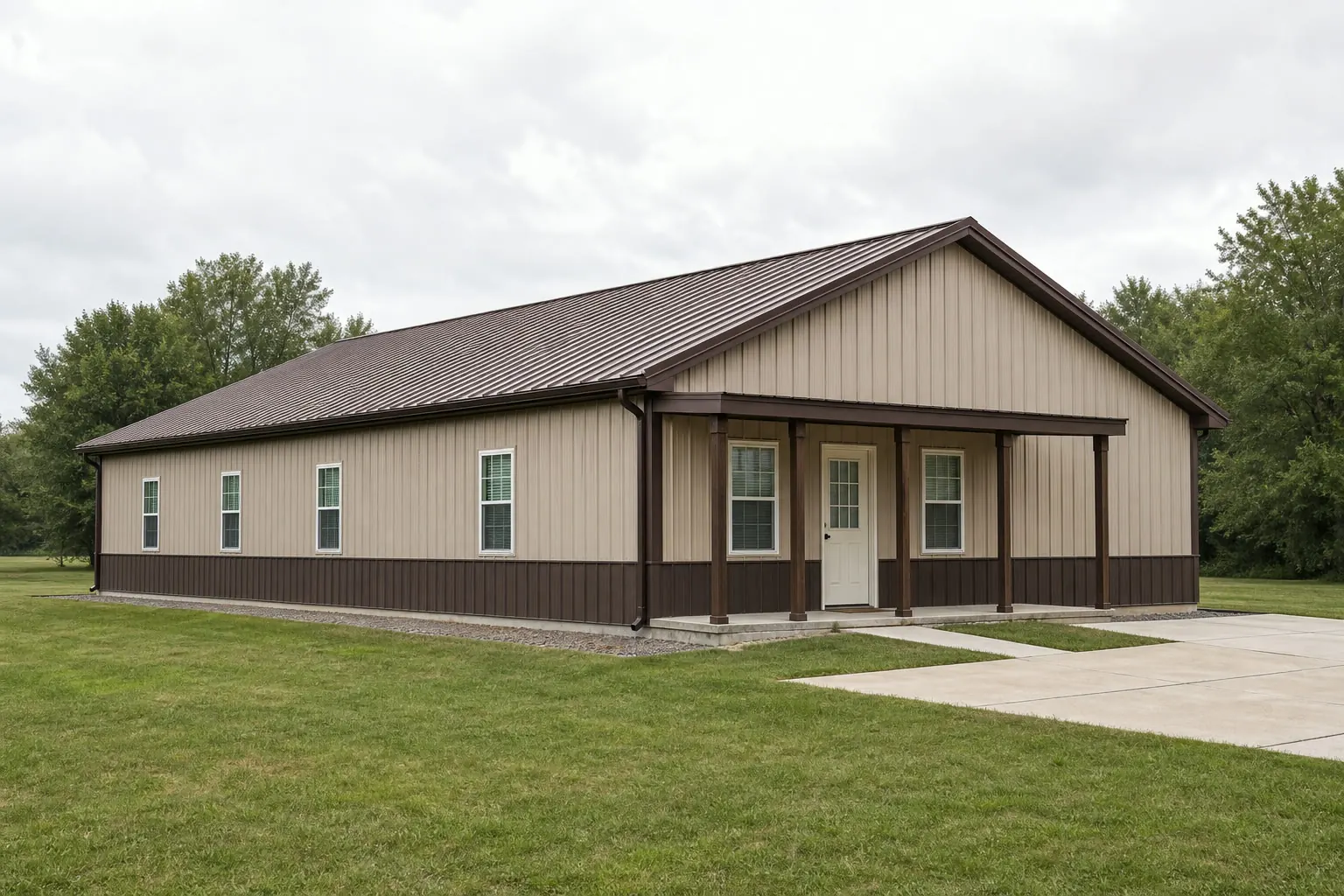
The Mississippi steel-home brief is a full-time residence, sometimes replacing an existing home, without a shop or equipment program attached.
 Primary full-time residenceA single-family steel-frame home built as a permanent residence, sized around bedrooms and living space rather than storage.Rebuild on an existing parcelSome Mississippi buyers are replacing a previous structure and specifically want a steel frame for the rebuild.Retirement or downsizing homeA smaller, efficient steel-frame residence sized for one or two occupants rather than a family footprint.
Example Configuration — for planning purposes only.
Get Mississippi steel home quotes
Tell us your county, target footprint and finish level. We route it with the Mississippi and steel-home context already attached.
Footprint
Sizes that suit a Mississippi steel home
Mississippi steel-home enquiries generally follow ordinary single-family footprints rather than the shop-plus-living splits seen on barndominium pages.
30′ × 40′
1,200 sq ft
A compact starting footprint for a smaller or single-occupant residence.
40′ × 60′
2,400 sq ft
A common mid-range family home footprint.
50′ × 80′
4,000 sq ft
A larger residence, sometimes with an attached garage bay rather than a full shop.
Example Configuration — for planning purposes only.
Footprint pages carry the layout detail for each of these; this page only explains why the Mississippi brief lands in this range.
Hazard & context
A county-level hazard check, set against a steady homebuilding backdrop
FEMA's statewide hazard average masks real county differences, and Mississippi's ordinary construction volume means local departments handle residential steel-home filings routinely.
FEMA's National Risk Index reports Mississippi's 82 counties averaging a composite hazard score of 50.9 out of 100, a figure FEMA itself describes as among the higher state averages nationally. That average is not a single project's answer: it hides real spread between counties, so pulling the specific county's own NRI entry before finalizing siting is a more useful step than relying on the statewide mean.
That hazard check happens against a construction backdrop that is genuinely ordinary rather than unusual. The Census Bureau recorded 7,700 new privately-owned housing units authorized statewide in 2023, including 7,145 single-family buildings, which means local building departments and contractors are working with steady residential volume, not a rare or novel filing type, when a full-time steel-frame home comes through the process.
- County-specific hazard score
- Pull the individual county's FEMA NRI entry rather than relying on the statewide 50.9 average.
- Ordinary residential filing
- A full-time steel home fits inside Mississippi's regular single-family permitting volume, not a novel category.
- Region before foundation
- Confirm Delta, loess or Coastal Plain ground before the foundation type is finalized.
Questions
Mississippi steel home questions
Questions we can answer honestly at state level, with the ones we cannot routed to whoever actually owns them.
It can. The Mississippi Encyclopedia's landform reference puts the state's total relief at 806 feet between the Gulf coastline and Woodall Mountain, so grading needs differ by where on that span a parcel sits; a local surveyor or engineer should confirm specifics for your site.
Yes. MSU Extension groups Mississippi ground into Delta alluvial, loess and Coastal Plain regions, and that grouping is a reasonable starting point for foundation and drainage planning, though a site-specific soils check should confirm it.
Mississippi's climate is humid subtropical with year-round rainfall potential, per NWS Jackson's own climate-normals materials. Whether a specific design and insulation approach suits your site is a question for your builder and your local building department; we do not make a blanket suitability claim here.
A steel home is planned purely as a residence, with no shop or equipment bay in the program. A barndominium is planned from the start as combined living space and a shop or storage bay. Discuss which format fits your use with your builder.
Permit requirements depend on your county and the structure's use as a residence, which typically triggers full residential building code review. Your local building department is the only reliable source for that answer.
FEMA's National Risk Index reports Mississippi's 82 counties averaging a composite score of 50.9 out of 100, among the higher state averages nationally, but that is a statewide mean — pull your specific county's score before finalizing siting.
There is no official typical size. Enquiries generally follow ordinary single-family footprints, most often in the 30x40 to 50x80 range, without a shop or storage bay factored into the size.
Sources for the Mississippi facts on this page
This page states no code requirement, wind speed, snow load, permit rule, price or supplier claim. The state-specific facts it does use are listed with their publisher below.
The total relief of Mississippi, from the Gulf coastline to the state's highest point at Woodall Mountain near Iuka, is 806 feet, and the state's landforms are grouped into physiographic regions.
Mississippi Humanities Council (Mississippi Encyclopedia) · Reference material · Tier 2
https://mississippiencyclopedia.org/entries/landforms/Mississippi State University Extension identifies the Mississippi Delta as an alluvial-plain land resource area with soils formed from sediments left by the Mississippi River, distinct from the state's loess and coastal-plain regions.
Mississippi State University Extension Service · Extension reference material · Tier 2
https://extension.msstate.edu/agriculture/soils/mississippi-land-resource-areasNWS Jackson publishes 1991-2020 climate normals information for its Mississippi forecast area, describing a humid subtropical climate with year-round rainfall potential.
National Weather Service (NOAA), Jackson MS office · 1991-2020 · Tier 1
https://www.weather.gov/jan/climatenormals1991-2020FEMA's National Risk Index reports Mississippi's 82 counties with a mean composite NRI risk score of 50.9 on FEMA's 0-100 relative scale (v1.20 release), among the higher state averages nationally.
Federal Emergency Management Agency (FEMA) · NRI v1.20 dataset · Tier 1
https://www.fema.gov/flood-maps/products-tools/national-risk-indexBuilding permit offices in Mississippi authorized construction of 7,700 new privately-owned housing units in 2023 (7,145 single-family buildings plus multi-unit structures).
U.S. Census Bureau · 2023 (final annual) · Tier 1
https://www2.census.gov/econ/bps/State/st2023a.txt