
Metal cabin · TX
Metal Cabins in Texas
A metal cabin in Texas is usually a rural build, and rural Texas is a specific place: the state carries more farms than any other in the country, at 230,662 operations averaging 544 acres each. That context matters because a cabin going up on acreage runs through county-level review rather than one statewide building code — Texas has no single statewide authority enforcing a mandatory code for most construction — and because the land itself changes character across the state, from Hill Country limestone to Blackland clay to Gulf Coast flatland to Trans-Pecos high desert. This page is about what a Texas acreage site actually changes for a cabin build, not a generic description of what a metal cabin is.
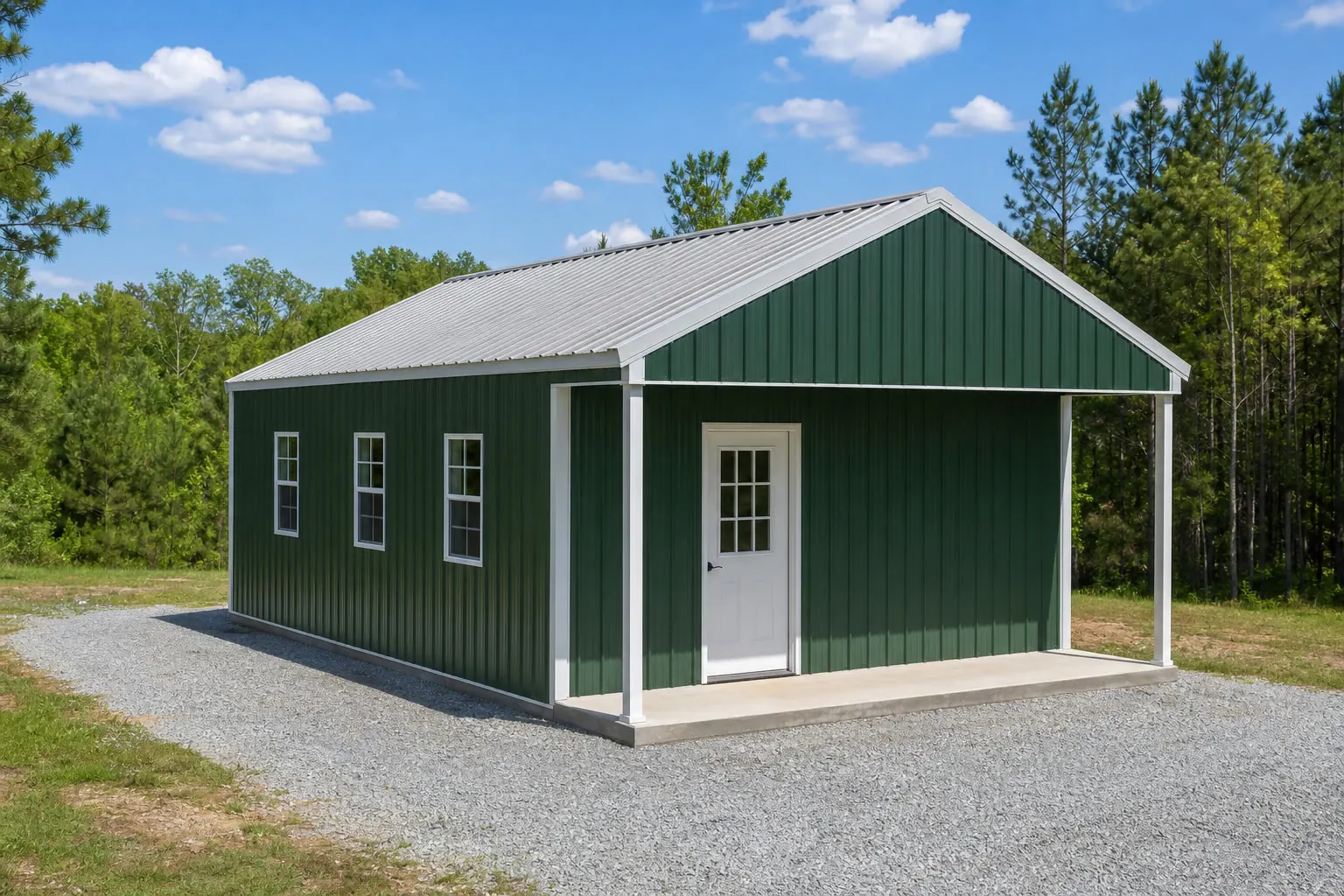
The intersection
What a Texas acreage site actually changes about a cabin
A metal cabin is rarely a Texas city-lot build. It is far more often a rural acreage build, and rural Texas sets both the review path and the ground conditions.
Texas leads the country in farm count, with 230,662 farms recorded in USDA's 2022 Census of Agriculture, and an average operation size of 544 acres across 125,471,325 total acres of farmland. That scale matters for a cabin buyer because it describes the typical parcel: large, often unincorporated, and frequently used for a mix of agricultural and recreational purposes. A metal cabin sited on that kind of acreage is a genuinely different project than one going up in a platted subdivision.
Texas does not have a single statewide building code authority enforcing a mandatory code for most construction; adoption and enforcement occur primarily at the local and municipal level, per the Texas State Law Library and independent reporting on the state's regulatory structure. For unincorporated county land, that often means a lighter review process for an accessory or recreational structure than an incorporated city would apply — but that is a county-by-county judgment, not a statewide rule, and it is worth a direct call to the county's building or floodplain office before finalizing a site plan.
Terrain is the other variable. The Bureau of Economic Geology's physiographic map splits Texas into Gulf Coastal Plains, Interior Plains and Blackland Prairies, Great Plains or High Plains, and the Basin and Range province of the Trans-Pecos, across 261,226 square miles. A cabin site on Hill Country limestone in the Interior Plains behaves differently underfoot than one on Gulf Coast sandy loam or Trans-Pecos rocky high desert — access roads, foundation piers, and drainage all follow from the specific region, not from a generic Texas description.
Site context
How rural cabin sites differ across Texas terrain
The physiographic region a cabin sits in shapes access, foundation and drainage decisions more than the building type does.
Gulf Coastal Plains
Flat, often low-lying ground with drainage as the recurring concern for a cabin's pad and approach road.
Interior Plains / Blackland Prairies
Central Texas clay and limestone country, including Hill Country, where pier foundations are common to handle expansive or rocky soils.
Great Plains (High Plains)
Flat, elevated, wind-exposed acreage across the Panhandle, where a cabin's orientation and windbreak planning matter more than in sheltered terrain.
Basin and Range (Trans-Pecos)
Rugged, remote far-west Texas terrain where access road grading is often the larger cost than the cabin itself.
Site realities
Utilities and access on large Texas acreage
A 544-acre average farm size means a cabin site is frequently well removed from paved road frontage or existing utility service.
With Texas farmland averaging 544 acres per operation across 125,471,325 total acres, a cabin buyer on family land is often placing the structure somewhere well interior to the property, not at a road-facing edge. That raises practical questions before design starts: how far is the site from the nearest grid connection or whether off-grid power and water are the plan, and what condition the access road is in for material delivery and crane or crew access during erection.
None of that is a statewide rule — it is a function of the specific parcel — but it is worth mapping before requesting a quote, since site access and utility distance change the installed cost more than the cabin's square footage does.
Get Texas metal cabin quotes
Tell us your county, your acreage's access conditions and your utility plan. We route it with the Texas and cabin context already attached.
Configuration
What Texas metal cabins are usually asked to do
Texas cabin briefs cluster around a handful of rural use cases, and the use case drives insulation and utility choices more than location does.
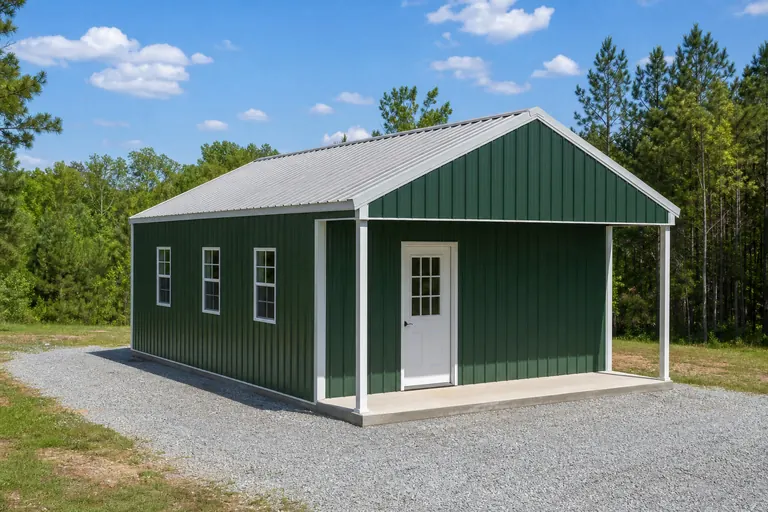 Hunting or weekend retreatA compact, simply serviced cabin on ranch or lease land, often with minimal utility hookup and a focus on weatherproofing.Ranch or farm-hand quartersA small, livable cabin near working buildings, usually needing full utility service and closer proximity to the main operation.Guest or second structure on a homesteadA cabin added to an existing rural property, where the site is already served by power and water and access is not a constraint.
Example Configuration — for planning purposes only.
Footprint
Sizes that suit common Texas cabin briefs
These ranges give a starting point for a Texas acreage cabin before a site-specific plan is drawn.
16′ × 24′
384 sq ft
A minimal weekend or hunting cabin with a single main room.
20′ × 30′
600 sq ft
Room for a bedroom, bathroom and small kitchen area.
24′ × 36′
864 sq ft
A cabin sized for longer stays or a small family group.
30′ × 40′
1,200 sq ft
Larger ranch-quarters or multi-use cabins with separated living space.
Example Configuration — for planning purposes only.
Footprint pages carry layout and door detail; this page explains why Texas briefs land in this range.
Preparation
Before you request a Texas metal cabin quote
Four things resolved in advance make the difference between a comparable quote and a re-quote on a rural site.
Step 1
Confirm your county's rural building process
Texas has no statewide code authority, and unincorporated county requirements for an accessory or recreational structure vary; call the county office directly.
Step 2
Map your access road
On large acreage, delivery and crane access to the cabin pad often matters more to the quote than the building spec.
Step 3
Decide your utility plan
Grid-connected, well-and-septic, or fully off-grid changes the cabin's design and the site-work scope substantially.
Step 4
Identify your region's ground type
Hill Country limestone, Blackland clay, Gulf Coast soil and Trans-Pecos rock each call for a different foundation approach.
Questions
Texas metal cabin questions
Questions we can answer honestly at state level, with the rest routed to whoever actually owns them.
It depends on the county and whether the parcel is incorporated. Texas has no single statewide building code authority; permitting for accessory or recreational structures is decided locally, so check with your specific county or municipal building office.
Texas farms average 544 acres, per USDA's 2022 Census of Agriculture, which means many cabin sites are well interior to the property. That affects access-road condition and utility distance more than the cabin's design.
There is no official typical size; most enquiries fall between 16x24 for a minimal weekend cabin and 30x40 for a larger ranch-quarters or family cabin.
We do not publish state-level prices, because a credible number depends on specification, utility hookup and site access. Our cost pages cover what drives the number.
Yes in practice: Hill Country limestone, Blackland clay, Gulf Coast soil and Trans-Pecos rocky ground each favor different foundation approaches, which your builder or engineer should confirm for the specific site.
Many rural Texas cabin sites are off-grid or partially off-grid given the distance from utility lines on large acreage; whether that is required or simply chosen depends on the specific parcel and county rules.
Sources for the Texas facts on this page
This page states no code requirement, wind speed, snow load, permit rule, price or supplier claim. The state-specific facts it does use are listed with their publisher below.
Texas does not have a single statewide building code authority enforcing a mandatory building code for most construction; code adoption and enforcement occur primarily at the local/municipal level.
KHOU 11 (Verify) / Texas State Law Library · current · Tier 3
https://www.khou.com/article/news/verify/verify-statewide-enforced-residential-building-code-texas/285-cc7c6343-cdf1-4751-b855-713601cf6b8bTexas had 230,662 farms in 2022 per the USDA Census of Agriculture, the most of any U.S. state.
USDA National Agricultural Statistics Service (NASS) · 2022 · Tier 1
https://www.nass.usda.gov/Publications/AgCensus/2022/Full_Report/Volume_1,_Chapter_1_State_Level/Texas/Land in farms in Texas totaled 125,471,325 acres in 2022.
USDA NASS · 2022 · Tier 1
https://www.nass.usda.gov/Publications/AgCensus/2022/Full_Report/Volume_1,_Chapter_1_State_Level/Texas/The average farm size in Texas was 544 acres in 2022.
USDA NASS · 2022 · Tier 1
https://www.nass.usda.gov/Publications/AgCensus/2022/Full_Report/Volume_1,_Chapter_1_State_Level/Texas/The USGS-published Bureau of Economic Geology map identifies major Texas physiographic regions including the Gulf Coastal Plains, Interior Plains, Great Plains, and Basin and Range provinces.
Bureau of Economic Geology, University of Texas at Austin · 1996 · Tier 2
https://txmn.org/st/files/2022/09/BEG_PHYSIOGRAPHY_1996.pdfTexas's total land area was 261,226 square miles per the 2008 Census Bureau state area measurements, the largest of the contiguous 48 states.
U.S. Census Bureau, Statistical Abstract of the United States: 2011 · 2008 · Tier 1
https://www2.census.gov/library/publications/2010/compendia/statab/130ed/tables/11s0355.pdfNOAA's NCEI State Climate Summary reports that temperatures in Texas have risen almost 1.5°F since the beginning of the 20th century.
NOAA National Centers for Environmental Information · 2022 report, covering 20th century-present · Tier 1
https://www.txdot.gov/content/dam/docs/division/env/toolkit/725-01-rpt-appendixb.pdf