
Indoor sports facility · TX
Indoor Sports Facilities in Texas
An indoor sports facility is built around one uninterrupted clear span over a court or turf playing surface, plus assembly occupancy for spectators — and both of those drive Texas-specific questions that a generic warehouse never has to answer. Assembly occupancy for bleacher or gathering space typically pulls in more code scrutiny at the municipal level, and Texas reviews that scrutiny locally rather than under one statewide authority. A long-span truss roof also presents a far larger uninterrupted surface to the wind than a compact building, which matters directly if the site falls inside the Texas Department of Insurance's coastal catastrophe area. And the substrate under a full-size court or turf field — flat, dimensionally consistent, properly drained — depends on which of Texas's physiographic regions the site sits in. None of that is a commercial-building question; it is specific to putting a large clear span and a playing surface on a Texas parcel.
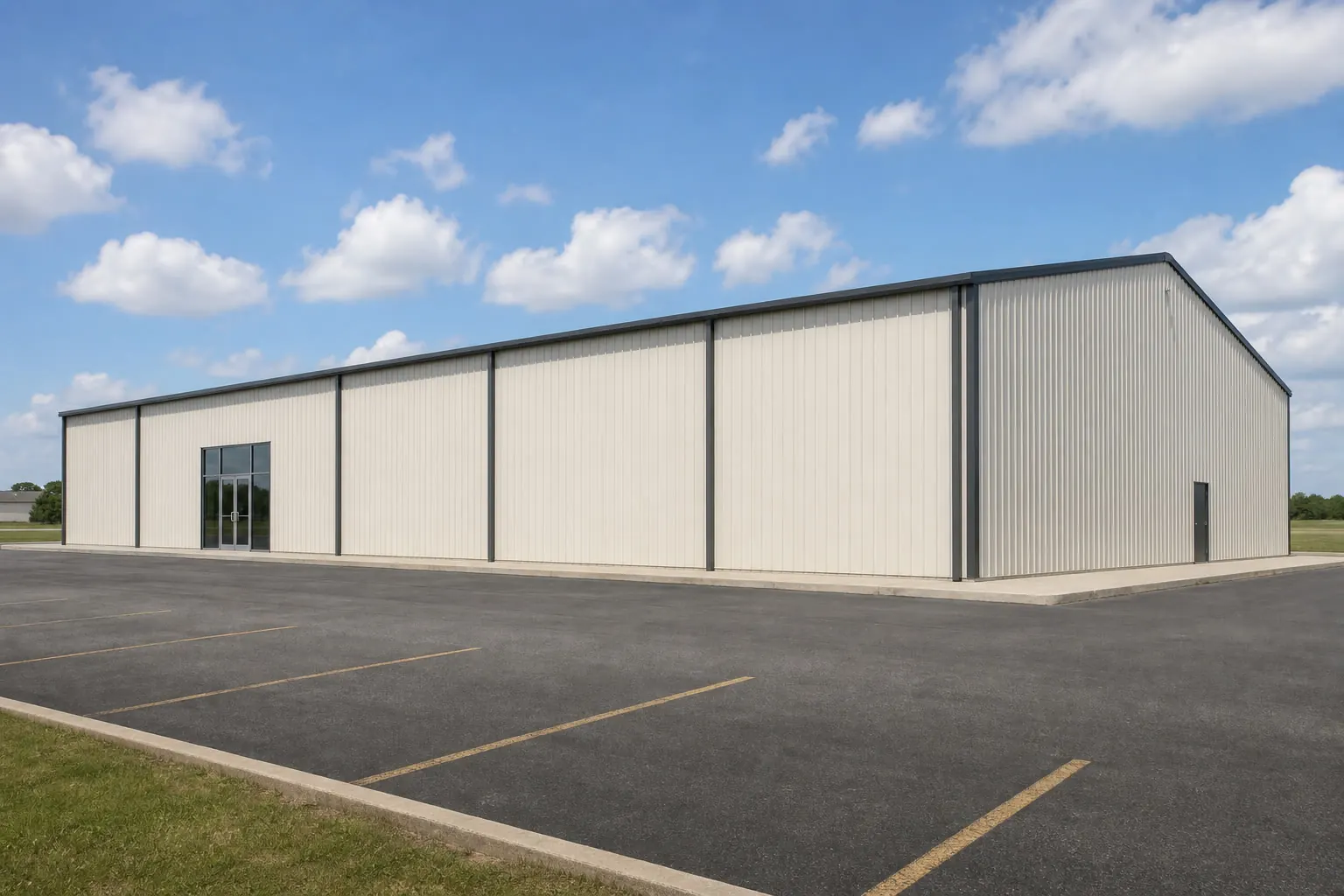
The intersection
Clear span and occupancy are what make this a distinct Texas build
A single unbroken clear span over a court or field, combined with assembly occupancy for spectators, drives an approval path, a wind-exposure profile, and a foundation conversation that a small outbuilding never triggers.
The defining structural feature of this building type is a clear span wide enough to leave a court or turf field free of interior columns — often 80 to 150-plus feet of unobstructed truss. Pairing that span with bleacher or spectator seating usually shifts the occupancy classification toward assembly use, and assembly occupancy tends to draw more detailed local plan review than a simple storage building, because egress width, aisle spacing and occupant-load calculations become live design questions. Texas has no single statewide building code authority enforcing a mandatory code for most construction, so the specific municipality's process — and how it treats assembly occupancy in a large clear-span structure — is the first thing to confirm, well before truss sizing or floor plan work begins.
That same clear-span roof carries a wind-exposure profile different from a smaller building: an unbroken 150-foot truss span presents far more roof surface for wind uplift to act on than a subdivided commercial roofline, which is exactly why bracing and connection detail matter as much as the primary frame size. If the site sits inside the Texas Department of Insurance's designated coastal catastrophe area — 14 coastal counties plus part of Harris County east of Highway 146, under the Windstorm Inspection Program established in 1987 with inspections beginning in 1988 — a Windstorm Certificate of Compliance under Insurance Code Chapter 2210 has to be secured before the building can carry windstorm coverage. NOAA's Hurricane Research Division records 64 direct hurricane hits on Texas between 1851 and 2018, second only to Florida, which is the backdrop for why that certification track exists specifically for coastal long-span roofs like this one.
The playing surface itself sets the third condition: a full-size court or turf field needs a flatter, more dimensionally stable substrate than a general storage floor, because uneven settling shows up immediately in ball roll and player footing. The Bureau of Economic Geology's physiographic map divides Texas into Gulf Coastal Plains, Interior Plains and Blackland Prairies, Great Plains or High Plains, and the Basin and Range province of the Trans-Pecos, across a 261,226-square-mile land area. Blackland clay under a court slab moves seasonally in a way that a warehouse floor's looser flatness tolerance can absorb but a regulation court cannot, which is why substrate testing belongs earlier in planning here than it would for a general commercial building.
Site context
How site conditions for a large facility differ across Texas
The Bureau of Economic Geology's physiographic regions frame what to expect before ground is broken on a large-footprint building.
Gulf Coastal Plains
Flat, often poorly drained ground; positive drainage under a court or turf slab has to be engineered rather than assumed, and this is also the zone where windstorm certification applies to insured coastal parcels.
Interior Plains / Blackland Prairies
Expansive clay moves seasonally under a large slab, which shows up as out-of-tolerance flatness on a regulation court well before it would register as a problem on a general storage floor.
Great Plains (High Plains)
Flat, wind-exposed Panhandle and West Texas ground, where lifting and bracing a long unsupported truss span during erection has to account for sustained wind more than in a sheltered metro site.
Basin and Range (Trans-Pecos)
Rugged far-west Texas terrain where grading and access for a wide clear-span footprint, not the truss package itself, tend to set the site-work budget.
Exposure
Occupant load raises the stakes on a county-specific hazard picture
FEMA's National Risk Index scores 18 defined hazard types per county rather than assigning Texas one statewide profile, and a building holding public spectator occupancy has more reason to ask the question than a low-occupancy storage structure would.
A gymnasium or turf facility hosting games or tournaments concentrates more people under one clear-span roof at one time than most other building types on this footprint, which is exactly why the relevant hazard conversation for a coastal facility (hurricane, coastal flooding) needs to be treated separately from a Panhandle facility's (high wind, hail). This page does not assign design values to any hazard — that decision belongs to your engineer and the authority having jurisdiction — but it is worth raising the county-specific hazard question with your local building department alongside the permit application specifically because of the occupant load a sports facility carries.
If the site already sits inside TDI's designated catastrophe area, the windstorm certification process is the concrete next step for a long-span roof, and it is worth opening that conversation with TDI or your insurer before the truss package and construction documents are finalized.
Get Texas indoor sports facility quotes
Tell us your municipality, your parcel's coastal status and your program mix. We route it with the Texas and sports-facility context already attached.
Configuration
What Texas indoor sports facilities are usually asked to do
Texas briefs for this building type sort by playing surface first — court, turf, or a coastal-zone variant — because the surface, not the location, sets clear-span width and roof height.
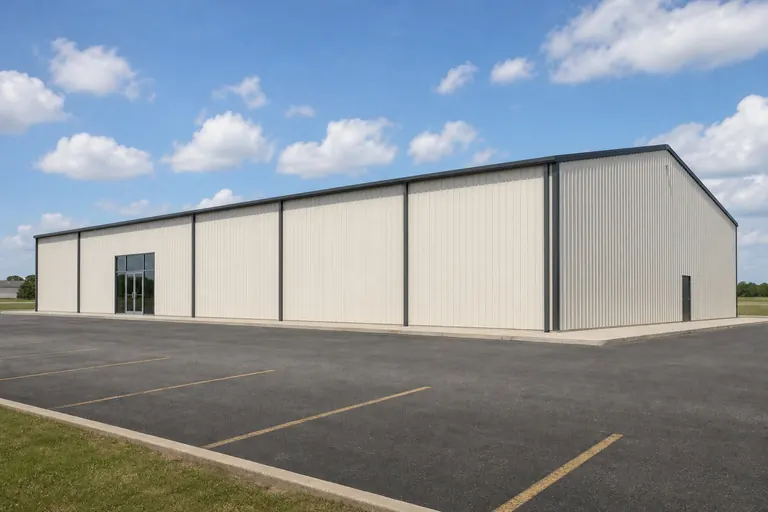 Multi-court gymnasiumOne or more basketball or volleyball courts under a single clear span, often with modest spectator seating along one side.Indoor turf and training fieldA long clear span for a turf field, frequently paired with batting cages or training bays along a sidewall.Coastal-zone athletic facilityA building inside the TDI catastrophe area that will need windstorm certification before it carries windstorm coverage. Confirm the certification path with TDI before finalizing design.
Example Configuration — for planning purposes only.
Footprint
Sizes that suit common Texas sports-facility briefs
These ranges give a starting point for this building type before a site-specific plan is drawn.
80′ × 150′
12,000 sq ft
A single full-size court or a compact turf training space.
100′ × 200′
20,000 sq ft
Room for a court plus modest spectator seating or a training annex.
120′ × 240′
28,800 sq ft
Multi-court or full turf-field programs with circulation space.
150′ × 300′
45,000 sq ft
Larger tournament-oriented or multi-use athletic facilities.
Example Configuration — for planning purposes only.
Footprint pages carry layout and door detail; this page explains why Texas briefs land in this range.
Preparation
Before you request a Texas indoor sports facility quote
Four things resolved in advance make the difference between a comparable quote and a re-quote on a project this size.
Step 1
Confirm occupancy classification with your local building department first
Spectator seating typically shifts the review toward assembly occupancy, which drives egress and aisle requirements a storage-occupancy shop never faces, and Texas reviews this locally rather than under a statewide standard.
Step 2
Check your parcel's coastal status before finalizing the truss design
If it is inside TDI's designated catastrophe area, start the windstorm certification conversation early, since a wide unsupported clear span exposes more roof surface to wind than a subdivided commercial roofline.
Step 3
Order substrate testing for your specific region
Blackland clay, High Plains ground and Gulf Coast soils each behave differently under a regulation court or turf slab, where flatness tolerances are tighter than on a general storage floor.
Step 4
Fix the court-versus-turf program before layout begins
The playing-surface decision sets clear-span width, roof height for ball flight, and door sizing more than total square footage alone.
Questions
Texas indoor sports facility questions
Questions we can answer honestly at state level, with the rest routed to whoever actually owns them.
Spectator or bleacher space typically shifts a building toward assembly occupancy, which draws more detailed local review of egress and occupant load than a storage-occupancy shop. Texas has no single statewide building code authority, so the specific requirement is set by your municipality — confirm with your local building department.
If the parcel is inside TDI's designated catastrophe area — 14 coastal counties plus part of Harris County east of Highway 146 — and the building will carry windstorm insurance coverage, a Windstorm Certificate of Compliance is required under Insurance Code Chapter 2210. Check with TDI or your insurer.
There is no official typical size; program drives it. Most enquiries fall between 80x150 for a single court or training space and 150x300 for multi-court or tournament-oriented facilities.
We do not publish state-level prices, because a credible number depends on span, spectator space, occupancy requirements and site work. Our cost pages cover what drives the number.
FEMA scores Texas counties individually across 18 hazard types rather than one statewide profile, so the relevant hazard set depends on your county. Ask your local building department and your engineer what applies to your specific site.
Yes in practice, though not as a fixed rule: clay-heavy Interior Plains sites, flat Gulf Coastal Plains sites, and High Plains sites each call for different drainage and foundation planning under a large slab, which your site engineer should confirm.
Sources for the Texas facts on this page
This page states no code requirement, wind speed, snow load, permit rule, price or supplier claim. The state-specific facts it does use are listed with their publisher below.
Texas does not have a single statewide building code authority enforcing a mandatory building code for most construction; code adoption and enforcement occur primarily at the local/municipal level.
KHOU 11 (Verify) / Texas State Law Library · current · Tier 3
https://www.khou.com/article/news/verify/verify-statewide-enforced-residential-building-code-texas/285-cc7c6343-cdf1-4751-b855-713601cf6b8bThe Texas Department of Insurance (TDI) administers a Windstorm Inspection Program for coastal construction, established under a 1987 state law, to allow structures to qualify for windstorm coverage.
Texas Department of Insurance (TDI) · since 1988 · Tier 2
https://www.tdi.texas.gov/wind/generalquestio.htmlThe Texas Windstorm Insurance Association (TWIA) requires coastal properties to hold a Windstorm Certificate of Compliance under Texas Insurance Code Chapter 2210 before TWIA wind/hail coverage is issued; TDI states the designated catastrophe area covers 14 coastal counties and part of Harris County east of Highway 146.
Texas Windstorm Insurance Association (TWIA) / Texas Department of Insurance (TDI) · current · Tier 2
https://www.tdi.texas.gov/tips/need-windstorm-inspection.htmlNOAA's Hurricane Research Division data show Texas has recorded 64 direct hurricane hits (all categories) for 1851-2018, second only to Florida.
NOAA Atlantic Oceanographic and Meteorological Laboratory (AOML), Hurricane Research Division · 1851-2018 · Tier 1
https://www.aoml.noaa.gov/hrd/tcfaq/E19.htmlFEMA's National Risk Index scores U.S. communities, including Texas counties, across 18 defined natural hazard types.
FEMA · current dataset · Tier 1
https://www.fema.gov/about/openfema/data-sets/national-risk-index-dataTexas's total land area was 261,226 square miles per the 2008 Census Bureau state area measurements, the largest of the contiguous 48 states.
U.S. Census Bureau, Statistical Abstract of the United States: 2011 · 2008 · Tier 1
https://www2.census.gov/library/publications/2010/compendia/statab/130ed/tables/11s0355.pdfThe USGS-published Bureau of Economic Geology map identifies major Texas physiographic regions including the Gulf Coastal Plains, Interior Plains, Great Plains, and Basin and Range provinces.
Bureau of Economic Geology, University of Texas at Austin · 1996 · Tier 2
https://txmn.org/st/files/2022/09/BEG_PHYSIOGRAPHY_1996.pdf