
Horse barn · UT
Horse Barns in Utah
A Utah horse barn project usually starts with a land question rather than a stall count. The Congressional Research Service's federal land ownership dataset puts Utah's federal acreage at roughly 33.3 million of the state's approximately 33.6 million total acres, and the state's own School and Institutional Trust Lands Administration manages further sections granted to benefit Utah schools and institutions. Against that backdrop, the private parcel a barn actually gets built on sits inside one of three physiographic provinces — Rocky Mountain, Colorado Plateau, or Basin and Range — each with its own grading and access story. None of that changes how a stall is framed, but all of it changes where and how a Utah horse-barn buyer can even start.
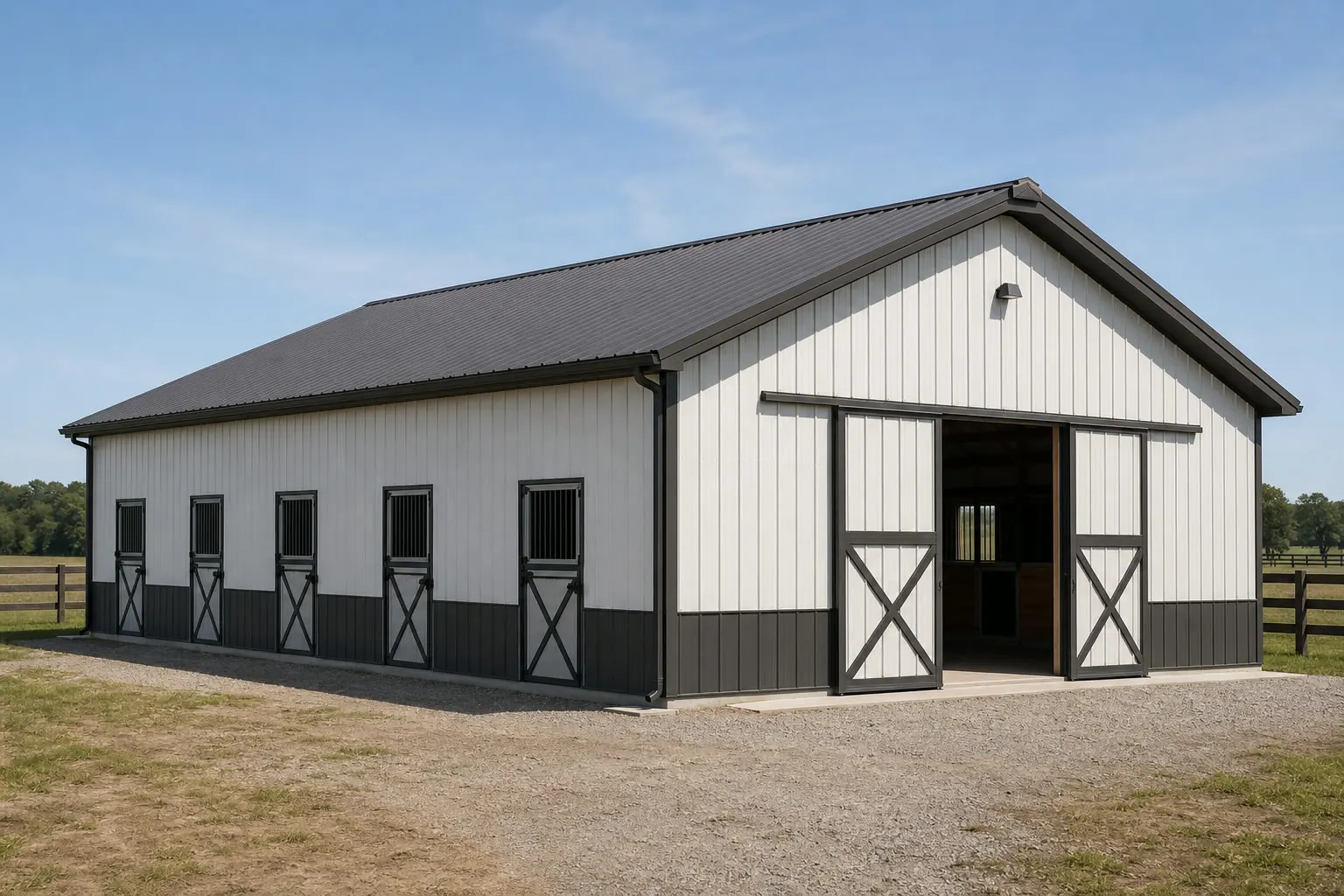
The Utah Variable
Confirm the Ground Before You Confirm the Barn
Utah carries an unusually large federal and state-trust land share, so a horse-barn buyer's first practical step is confirming the parcel is genuinely private.
The Congressional Research Service's federal land ownership dataset lists Utah's federal acreage at roughly 33.3 million acres against a total state acreage of approximately 33.6 million — figures drawn from 2013 data reported in 2017, so treat them as a snapshot rather than a live count. Whatever the exact current figure, the scale is the practical point: private ground for a rural horse property is a comparatively thin share of Utah's total map, and a buyer should not assume open-looking rural land is available for private development without checking.
Utah's School and Institutional Trust Lands Administration adds a second layer. SITLA manages state trust land granted by Congress to benefit Utah schools and institutions, and these trust sections sit interspersed with federal and private land in parts of the state. A parcel that looks like ordinary private rangeland on a map can be a SITLA section a mile away from another that is genuinely private. A title search or a call to the county recorder and SITLA before committing to a site avoids planning a barn around ground that was never available to buy or build on in the first place.
Terrain
Three Provinces, Three Different Barn Sites
Utah's position at the meeting point of three physiographic provinces changes the site-prep and access conversation for a horse barn before it changes the stall plan.
Basin and Range (West)
Broad desert valley floors between isolated mountain ranges; generally flatter ground for a barn pad, though water access and summer heat exposure are worth planning for.
Rocky Mountain Province — Wasatch and Uinta Country (North/Northeast)
Bench and mountain-valley sites where grade, drainage off a slope, and a shorter high-elevation build season affect both construction timing and winter access to the barn.
Colorado Plateau (East/Southeast)
Canyon and mesa terrain where a barn's access road may need to route around drainages, and where feed and bedding delivery trips take longer than on a Wasatch Front-adjacent parcel.
Process
The Local Office Still Decides
Utah's push for uniform building codes does not remove the local building department from a horse-barn permit decision.
Utah's Division of Professional Licensing, within the Department of Commerce, administers the Uniform Building Standards Act and works with the Uniform Building Code Commission to promote statewide uniformity in code enforcement. That is a genuine effort toward consistency across jurisdictions, but plan review and permit issuance for a horse barn still happen at the county or city building department covering the parcel. The practical step is the same regardless of the uniformity program: identify the local office, ask whether the project qualifies for any agricultural-exempt or accessory-structure classification, and get the answer in writing.
That written answer should also address setbacks and any water-rights or irrigation-ditch easements, since Utah's agricultural parcels — averaging 604 acres in the 2022 Census — commonly carry water infrastructure that a barn footprint has to respect. Combined with the land-tenure check described above, a Utah horse-barn buyer is really clearing two separate gates before design starts: is the ground private, and what does the local jurisdiction require on it.
- Identify the county or city authority
- Utah's uniformity program runs through, not around, local plan review.
- Ask about agricultural or accessory-structure status
- Classification can change documentation requirements for the barn.
- Check for water-rights or ditch easements
- Common on Utah's larger agricultural parcels.
Get Utah Horse Barn Quotes
Tell us your county, roughly where the parcel sits, and whether ownership is confirmed private. We pass the site context through with the enquiry.
Comparison
Basin Floor Site Versus Mountain Bench Site
Two common Utah horse-barn contexts, and how the terrain drives different priorities.
| Design item | Basin and Range valley parcel | Rocky Mountain bench parcel |
|---|---|---|
| Dominant site concern | Heat and water access | Grade and slope drainage |
| Barn orientation driver | Prevailing wind across open basin | Bench slope and runoff routing |
| Build season | Generally longer, lower-elevation conditions | Shorter at higher elevation; plan around it |
| Access in winter | Usually consistent | Can be limited by snow; confirm plowing plan |
| Design values needed | Local department figures, basin context | Local department figures, mountain context — do not reuse basin numbers |
Dominant site concern
- Basin and Range valley parcel
- Heat and water access
- Rocky Mountain bench parcel
- Grade and slope drainage
Barn orientation driver
- Basin and Range valley parcel
- Prevailing wind across open basin
- Rocky Mountain bench parcel
- Bench slope and runoff routing
Build season
- Basin and Range valley parcel
- Generally longer, lower-elevation conditions
- Rocky Mountain bench parcel
- Shorter at higher elevation; plan around it
Access in winter
- Basin and Range valley parcel
- Usually consistent
- Rocky Mountain bench parcel
- Can be limited by snow; confirm plowing plan
Design values needed
- Basin and Range valley parcel
- Local department figures, basin context
- Rocky Mountain bench parcel
- Local department figures, mountain context — do not reuse basin numbers
Footprint
Barn Footprints Suited to Utah Sites
Utah briefs commonly pair the stall run with adjacent feed or equipment storage, reflecting how many parcels sit inside a larger working operation.
30′ × 40′
1,200 sq ft
A compact private barn with two to three stalls plus a small feed and tack area.
36′ × 48′
1,728 sq ft
Adds equipment or hay storage bay alongside the stall run, useful on a working parcel.
40′ × 60′
2,400 sq ft
Centre-aisle layout with room for tack, wash and larger feed storage.
Example Configuration — for planning purposes only.
Stall and aisle dimensions live on the footprint pages; this page explains why Utah briefs often add feed-storage adjacency and terrain-specific access planning.
Questions
Utah Horse Barn Questions
Answers grounded in Utah's evidence pack, with honest routing where a statewide figure does not exist.
Confirm it first. Roughly 33.3 million of Utah's approximately 33.6 million acres are federally owned, and SITLA manages additional state trust sections interspersed with private land. A title search or a call to the county recorder and SITLA settles this before design work starts.
It depends on the county or city and how they classify the structure and use. Utah's Division of Professional Licensing promotes statewide code uniformity, but plan review still happens locally, so the building department with jurisdiction over your parcel is the reliable source, confirmed in writing.
Yes. Utah sits at the convergence of the Rocky Mountain, Colorado Plateau, and Basin and Range provinces, and grading, drainage and access needs differ meaningfully between a valley floor, a mountain bench, and mesa-adjacent ground.
We don't make a prevalence claim, but Utah's 2022 Census average farm size of 604 acres suggests many horse-keeping parcels have room for a barn alongside hay storage or equipment access rather than standing alone on a small lot.
No verified single statewide figure exists in this evidence pack, and Utah's elevation range — over 11,000 feet between its lowest and highest points — makes a single number unreliable. Your local building department and project engineer set the design values for your specific site.
Sequence
Order of Operations for a Utah Barn
Land tenure and terrain questions belong at the start of a Utah horse-barn project, not after a quote is in hand.
- Confirm the parcel is privateCheck federal and SITLA trust-land status before committing to a site.
- Identify your terrain provinceBasin and Range, Rocky Mountain bench, or Colorado Plateau each raise different site-prep questions.
- Confirm your local building department's positionClassification, setbacks, easements and documentation, in writing.
- Check for water-rights or ditch easementsCommon on Utah's larger agricultural parcels and can constrain the buildable footprint.
- Get site-specific design values from an engineerEspecially important given Utah's elevation range; do not import a basin-floor figure to a mountain site.
- Then specify the barnStalls, aisle and storage adjacency, once the site and the authority have set the constraints.
Sources for the Utah facts on this page
This page states no code requirement, wind speed, snow load, permit rule, price or supplier claim. The state-specific facts it does use are listed with their publisher below.
CRS's federal land ownership dataset lists Utah federal acreage at roughly 33.3 million acres (2013 data) against total state acreage of approximately 33.6 million acres.
Congressional Research Service · data as of FY2013, report dated March 3, 2017 · Tier 1
https://www.everycrsreport.com/files/20170303_R42346_95ce191e74ed8e08054bb5476971544bc55823f2.htmlUtah's School and Institutional Trust Lands Administration (SITLA/Trust Lands Administration) manages state trust land granted by Congress to benefit Utah schools and institutions.
Utah Trust Lands Administration (SITLA) · current, accessed 2024 · Tier 2
https://trustlands.utah.gov/Utah lies at the convergence of three physiographic provinces: the Rocky Mountain Province (Uinta and Wasatch mountains) in the northeast, the Colorado Plateau in the east/southeast, and the Basin and Range in the west.
Utah Division of State History (History to Go) · current reference page · Tier 2
https://historytogo.utah.gov/unique-setting/Average Utah farm size in the 2022 Census was 604 acres, up about 3% from 2017.
USDA NASS · 2022 · Tier 1
https://www.nass.usda.gov/Publications/AgCensus/2022/Online_Resources/County_Profiles/Utah/cp99049.pdfUtah's Division of Professional Licensing (DOPL), within the Department of Commerce, administers the Uniform Building Standards Act and works with the Uniform Building Code Commission to promote statewide uniformity in code enforcement.
Utah Department of Commerce, Division of Professional Licensing · current, accessed 2024/2025 · Tier 2
https://commerce.utah.gov/dopl/uniform-building-codes/