
Commercial building · NY
Commercial Steel Buildings in New York
New York does not offer one commercial site condition; it offers at least two. Upstate counties still hold 30,650 farms working 6,502,286 acres of farmland, an average of 212 acres each, and a commercial steel building there frequently sits on or beside working agricultural ground with room to build outward. Downstate and metro sites are the opposite: constrained, previously developed parcels where municipal review, not land availability, sets the schedule. Whichever condition applies, the winter load case is shared statewide in character if not in exact figure — Albany's 1991-2020 normals record about 40.9 inches of annual precipitation and roughly 61 inches of snowfall, and FEMA's National Risk Index scores winter weather among the hazards it tracks for every New York county. This page addresses those New York-specific realities and routes code, cost and configuration questions to the pages and authorities that own them.
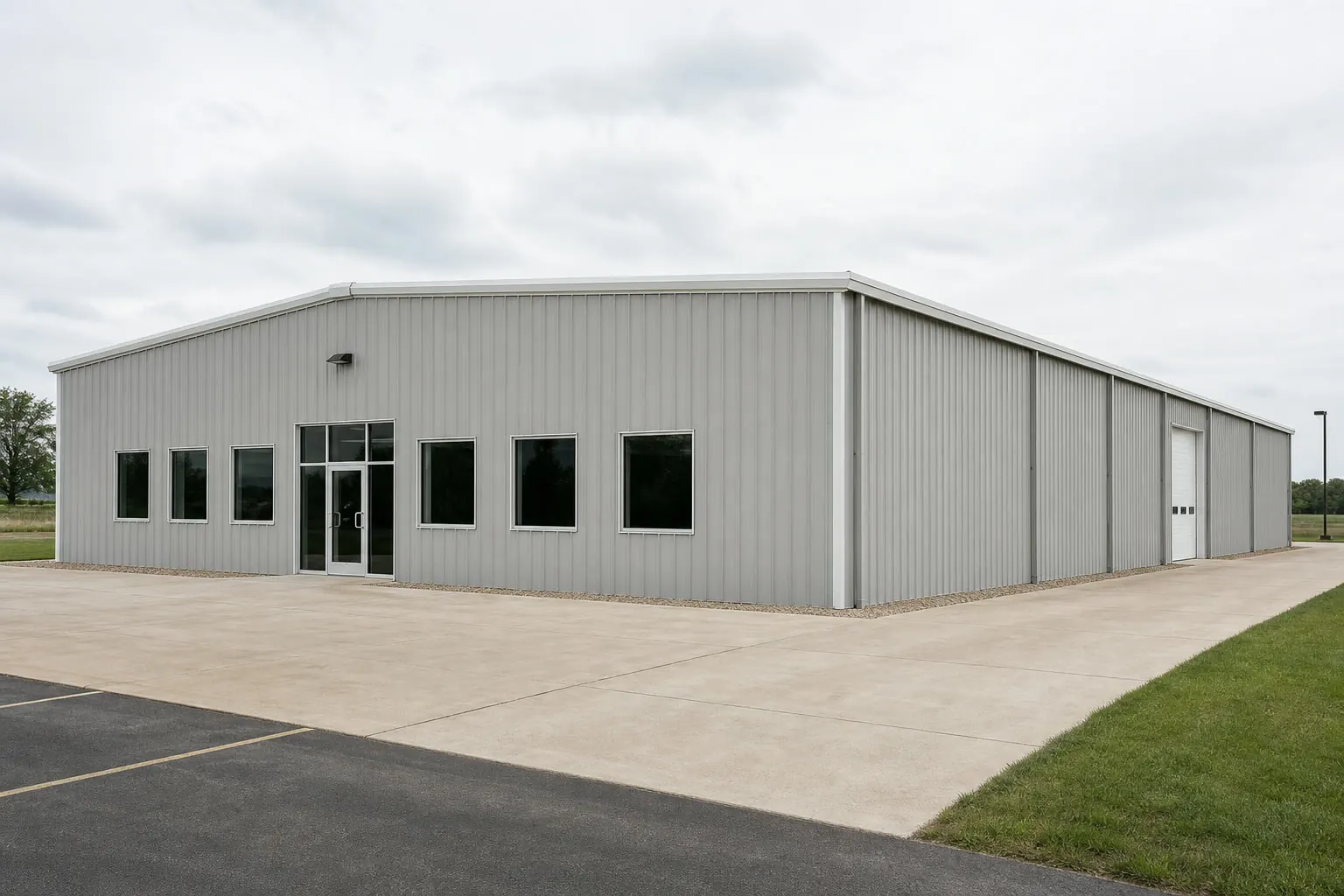
Two States in One: Upstate Room, Downstate Constraint
A New York commercial steel building project starts from one of two very different site conditions. Upstate, the state's 30,650 farms working 6,502,286 acres of farmland at a 212-acre average mean many commercial sites have real room to build outward, with greenfield foundation and utility work as the dominant cost driver. Downstate and metro New York offer the opposite: constrained, previously developed parcels where a municipal review calendar sets the schedule more than the site's geometry does. Both conditions share a winter load case — Albany's 1991-2020 normals put annual snowfall near 61 inches, and FEMA scores winter weather among the 18 hazard types it tracks for every New York county — but the design values themselves are set locally, never asserted here.
Site Selection
Match the Building Plan to the Site Condition You Actually Have
Confirm early whether your New York site is greenfield agricultural ground or constrained urban infill, because the two conditions drive different pre-construction budgets.
On an upstate parcel near or on working farmland, the practical questions are utility distance, well and septic capacity, access road condition and whether any part of the land carries an agricultural district designation or easement that affects development. New York's 212-acre average farm size means there is often genuine room to site the building efficiently, but 'room' does not mean 'no review' — county planning boards and local zoning still apply, and agricultural land conversions can trigger their own notice requirements.
On a downstate or metro parcel, the site itself is usually the constraint: an irregular shape, an existing foundation or slab, shared access, and neighbors whose sightlines and operations matter to the reviewing board. The critical path here is almost always municipal review — site plan approval, sometimes environmental review under state law, and then building permit — rather than land assembly or utility distance.
Either way, do not assume the New York answer is the same answer you would get in a neighboring state. Land use and building administration here run through the local jurisdiction, and the Census Bureau's ongoing Building Permits Survey tracks activity at the state and place level precisely because that activity varies so much by locality.
Site Brief
What to Resolve Before Specifying Steel
These items are where New York commercial projects most often lose time or money, and they differ by which site condition applies.
- Identify which of the two site conditions you haveAn upstate greenfield site and a downstate infill parcel carry different pre-construction budgets and different review paths; do not plan one against the assumptions of the other.
- Check for agricultural district or easement restrictionsOn or near working farmland in a state with a 212-acre average farm size, confirm with the county planning office whether any portion of the parcel carries an agricultural district designation that affects development timing.
- Map the municipal review sequence on infill sitesDownstate and metro New York review is local and calendar-driven; a missed submission deadline can cost a month even on an uncontested application.
- Get design loads from the professional of recordSnow load, wind speed and the applicable code edition come from your design professional and the local building department; NOAA's 1991-2020 normals are published station by station across New York, so your site's own values matter.
- Plan roof and clear-height for the winter load caseAlbany's normals show roughly 61 inches of annual snowfall, and FEMA scores winter weather among the hazards it tracks statewide by county; confirm your county's specific exposure before finalizing the roof design.
- Survey underground conditions on reused urban parcelsPreviously developed downstate sites frequently carry old foundations and utilities that shape foundation cost more than the steel frame does.
Get commercial quotes for your New York site
Tell suppliers whether your site is upstate acreage or downstate infill, your required clear span, and your municipality's review process. Those inputs make New York commercial quotes comparable.
Footprints
Common New York Commercial Footprints
The site condition — greenfield upstate or constrained downstate — usually decides how much footprint a New York project can absorb.
40′ × 60′
2,400 sq ft
Small service, trade or contractor premises that fits comfortably on a constrained downstate infill parcel.
60′ × 100′
6,000 sq ft
Light industrial or distribution use where an upstate site can support the footprint and truck circulation.
80′ × 120′
9,600 sq ft
Larger clear-span requirement, most viable on upstate acreage where municipal review supports the added coverage.
Example Configuration — for planning purposes only.
Coverage, parking and circulation requirements are set locally; confirm them before fixing a footprint.
Site Context
Upstate, Western New York and the Downstate Metro
Where a commercial site sits in New York changes both the review process and the practical construction conditions.
Upstate farm and rural counties
Home to much of the state's 30,650 farms and 6,502,286 acres of farmland, where commercial sites can be greenfield with real room to build, subject to county planning and any agricultural district review.
Western New York
NOAA maintains 1991-2020 station normals for locations including Albion in this region, a reminder that lake-effect-influenced snowfall can run heavier here than the Albany benchmark cited elsewhere on this page.
Downstate and metro New York
Dense, previously developed parcels where site plan review and, on larger projects, state environmental review, set the schedule; land assembly and underground conditions dominate the pre-construction budget.
Evidence Position
Sourced Facts and Deliberate Silences
Every New York figure above is federal; every regulatory number is left to your municipality and design professional.
Sourced: USDA NASS's 2022 Census of Agriculture farm count and acreage figures for New York, NOAA's Albany station 1991-2020 climate normals, FEMA's National Risk Index as the federal county-level hazard tool, and the Census Bureau's ongoing Building Permits Survey program covering New York at the state and place level.
Withheld: adopted code editions, occupancy classifications, design snow and wind values, permit fees, review timelines and prices. We also did not locate a directly-verified single statewide 2023 housing-permit total for New York in this evidence cycle, so no specific figure is asserted; the BPS program pages confirm the data exists without confirming the exact number here.
Questions
New York Commercial Building Questions
The New York answers a general commercial steel building page cannot give.
Usually, yes. Upstate sites often sit on or near the state's 6,502,286 acres of farmland with more room to build, while downstate and metro sites are typically constrained infill governed by local site plan review. Confirm which condition your parcel has before budgeting.
On downstate and metro sites, municipal site plan review and calendar-driven commission meetings are the usual driver. On upstate sites, agricultural district or easement checks can add time if not identified early.
Your design professional and local building department set that value. Albany's 1991-2020 normals show roughly 61 inches of annual snowfall as a representative station figure, and NOAA publishes normals station by station across New York, so your site's own data matters.
FEMA's National Risk Index scores 18 hazard types, including winter weather, at the county level for every New York county, and its report viewer is the sourced way to check your specific county rather than relying on a single statewide figure.
Often, subject to county planning review and any agricultural district designation on the parcel. New York's average farm size is 212 acres, so many upstate sites have room, but local approval still applies.
Pricing sits with the cost silo. The New York-variable drivers are whether the site is greenfield or reused, utility distance on rural parcels, foundation conditions on urban parcels, and the review timeline's effect on scheduling.
Sources for the New York facts on this page
This page states no code requirement, wind speed, snow load, permit rule, price or supplier claim. The state-specific facts it does use are listed with their publisher below.
New York had 30,650 farms in 2022, down 8% since 2017.
USDA National Agricultural Statistics Service (NASS) · 2022 · Tier 1
https://www.nass.usda.gov/Publications/AgCensus/2022/Online_Resources/County_Profiles/New_York/cp99036.pdfNew York had 6,502,286 acres of land in farms in 2022, an average farm size of 212 acres.
USDA NASS · 2022 · Tier 1
https://www.nass.usda.gov/Publications/AgCensus/2022/Online_Resources/County_Profiles/New_York/cp99036.pdfAlbany, NY's 1991-2020 annual normal precipitation is about 40.9 inches with roughly 61 inches of annual snowfall at the Albany station.
National Weather Service (NOAA), Albany NY office · 1991-2020 · Tier 1
https://www.weather.gov/media/aly/Climate/ALB_Normals_1991-2020.pdfFEMA's National Risk Index is the authoritative source for county- and state-level natural hazard exposure ratings across 18 hazard types, viewable via FEMA's own interactive report tool.
Federal Emergency Management Agency (FEMA) · Current NRI release · Tier 1
https://www.fema.gov/flood-maps/products-tools/national-risk-indexNew York state total privately-owned housing units authorized by building permits in 2023 was tracked in the Census Bureau's Building Permits Survey annual highlights, alongside all other states.
U.S. Census Bureau · 2023 · Tier 1
https://www.census.gov/construction/bps/pdf/2023annualhighlights.pdf